
What is peer-to-peer?
Imagine you’re a parent and your child has just been diagnosed with a chronic illness. While you understand the steps you need to take according to the health system, it’s not until you connect with another parent in the same position that you find a way to really live with this life change.
Welcome to the simple yet powerful world of peer-to-peer support, where support comes from someone who has successfully navigated a similar life experience.
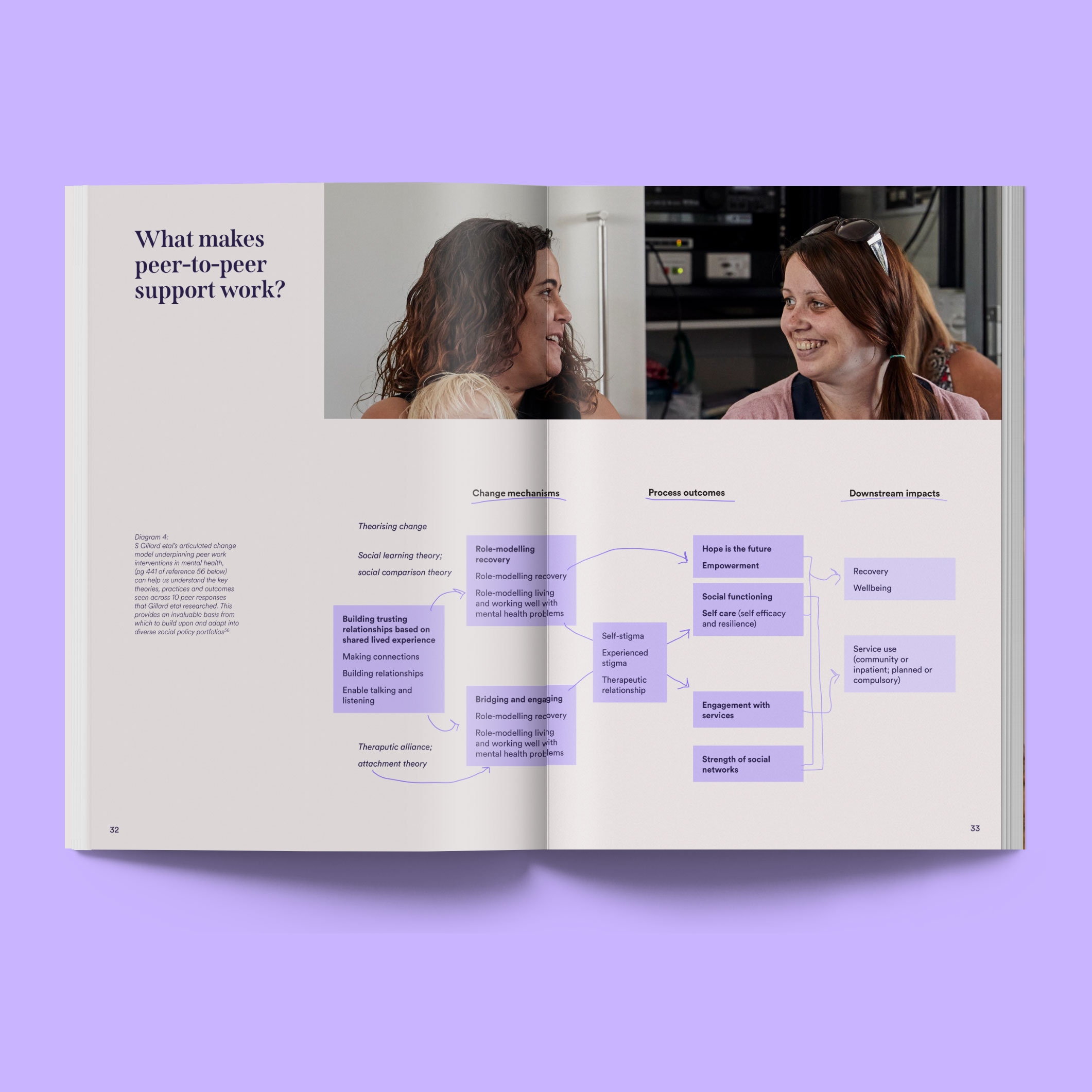
At TACSI, we like to describe it as a scaffolding of mutual support that connects people currently facing tough times with people who have successfully navigated similar challenges.
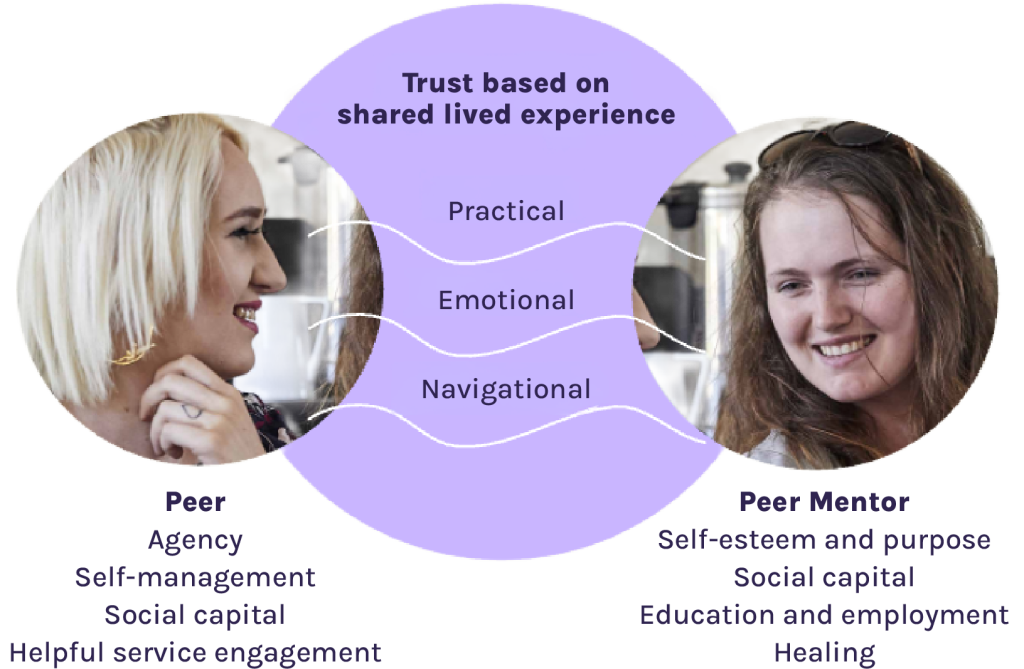
Peer-to-peer typically provides three types of help
- Practical support: Real-world tactics and day-to-day strategies for dealing with a specific situation, such as strategies to take your HIV drugs, navigate mental health challenges, stay sober, or connect to Culture.
- Growth support: Support to deal with the emotional complexity of the situation you’re in and pursue personal growth and development, such as being there when someone needs to talk, having high expectations and celebrating wins.
- Bridging support: Linking individuals back into positive community networks and cultural connections (and formal services when needed).
The power of
peer-to-peer
Governments face workforce shortages across social, mental health, and care sectors. Peer-to-peer models tap into the millions of everyday Australians who have lived through tough times and stand willing to support others – creating a new, cost-effective layer of community capability.
Many people reject the idea of formal services due to fear of judgement, bureaucracy, or past trauma. Peer models help to remove institutional stigma, offering non-judgmental, relational support. Rather than replacing professionals, peer-to-peer practices are a powerful complement that can bridge gaps in accessibility, particularly in remote areas or “thin markets”.
Far from just a ‘feel good’ way of doing things — peer-to-peer delivers quantifiable outcomes that reduce strain on public budgets. In a 2025 longitudinal research study by the University of Adelaide’s BetterStart team on TACSI’s peer-to-peer initiative Family by Family, there was a proven 44% relative reduction in the risk of children entering out-of-home care and a 6% relative reduction in emergency department presentations.
Peer-to-peer practices increase social capital, strengthen capability, build confidence and leadership, and reduce demand on acute and crisis services through early intervention, prevention and alternative more relational pathways.
Peer-to-peer is an impactful, low cost alternative to traditional professional services that can be delivered face-to-face, virtually or a blend of the two.
Learn more about how we can harness the power of lived and living experience.
Proven impact of peer-to-peer at TACSI
For over 15 years, we’ve applied peer-to-peer practices in areas as diverse as child protection, caregiving, domestic, family and sexual violence, gambling harm and young parenting.
TACSI peer-to-peer initiatives
Family by Family helps families experiencing setbacks by engaging and training families who have been through tough times and come out the other side to help other families going through tough times themselves. Over the last 15 years, Family by Family’s unique approach has supported over 2630 families in Australia and the UK to make lasting change in their lives. A 2025 longitudinal evaluation by the University of Adelaide’s BetterStart team showed a 44% relative reduction in the risk of children entering out-of-home care, and a 90% goal achievement rate for participating families.
Foster to Family is a toolkit and framework for practitioners in the foster sector to provide both birth parents and carers the support they need as they navigate through the stressful time of working toward restoration, and children the chance to get the support and love they need from all adults while safely staying in touch with birth parents.
Weavers brings the lived experience of caring for a significant other in support of those who are navigating the challenges of providing care. Impact for over 150 carers across 11 organisations has seen reduced social isolation, improved mental and physical health and increased advocacy for quality care.
The Virtual Village is designed for regional women, feeling isolated or experiencing poor mental or physical health as a result of family domestic or sexual violence. We pair women at the beginning of their healing and recovery journey with trained volunteers who are also on their own healing and recovery journey.
TACSI-supported peer-to-peer projects and case studies
Peer-to-peer training and coaching with the CUBE Centre in Wales: We partnered with Welsh community support centre CUBE to train and coach practitioners alongside people with lived and living experience in peer-to-peer practices to support their restorative approaches to community offers. Resulting in a new program called side-by-side early evaluations are showing positive outcomes for families.
Supporting parents of children with a life limiting illness: We worked with the Women’s and Children’s Hospital’s Paediatric Palliative Care Unit and parents of children with life limiting illnesses to co-create a new peer-to-peer model of family support. This approach was awarded the ‘Excellence in Strengthening Partnerships 2022’ at the SA Health Awards.
Co-designing opportunities for better youth connection in regional South Australia: In July 2021, the Department of Human Services, the Office for Recreation, Sport and Racing, and Wellbeing SA engaged TACSI to recruit young people living in regional SA, and equip them with the skills, knowledge and confidence to become peer researchers. Their research into loneliness and youth connection in the regions resulted in key lived experience insights and recommendations being made to the government for improved service delivery and engagement.
Transforming retirement experiences across Australia: In 2017, TACSI, Think Human, Port Adelaide Enfield Council and older people themselves co-designed a peer-based retirement transition program called Mindset for Life.
Supporting South Australians to age well: In 2019, we wrote a report for the Office for Ageing Well on the theme ‘Listening to how we can support South Australians to age well’. In 2020, we engaged with a diverse range of government, non-government and community stakeholders to build on this work, the result of which was the South Australia’s Plan for Ageing Well 2020-2025.
Other examples of peer-to-peer models around the world
Alcoholics Anonymous (International) has been providing mutual support to members since 1930, through meetings, peer support and a Twelve Steps program to guide participants through recovery. The model has been scaled globally and adapted, including Narcotics Anonymous, Cocaine Anonymous and Overeaters Anonymous.
Parents as Teachers International & Family Support Network (Australia) connects parents and has demonstrated positive outcomes relating to child protection system, health service use, out-of-home care, education, mental health and behaviour, wellbeing and parenting. The program has scaled across the United States, United Kingdom, Canada, Switzerland, Germany, Guam and Australia.
Prisoners as Change Makers (Red Cross, Australia) has “increased social capital and decreased likelihood of reoffending” amongst incarcerated peers and peer mentors. They have two programs: ‘Aboriginal and Torres Strait Islanders Mental Health Training’ and ‘Elders for Change’. The model has since been scaled to include Sisters for Change in Townsville.
Multicultural Youth Affairs Network NSW (Australia) runs ‘Welcome to Australia’ to help newly arrived overseas students settle into Australian life through peer led workshops and programs. Students learn Aussie slang, First Nations history and culture and life skills like swimming and financial literacy. The program encourages students to become active in their community and future peer mentors.
We’re fostering a national movement to integrate peer-to-peer approaches as a standard, commissioned part of Australia’s service systems.
Whether you’re a government commissioner, PHN leader, NFP, or community group, we can work together to design, trial, or evaluate a peer-to-peer model tailored to your sector.