


Introducing the National Futures Initiative
In 2023, we embarked on a journey to explore TACSI’s future as Australia’s national centre for social innovation by connecting with 30 visionary thinkers at the edges of our networks. These conversations uncovered how climate change, machine intelligence, and extremisms would not only challenge society but also deepen existing inequities without collective action.
Out of these conversations the National Futures Initiative emerged: a commitment to building national capability to realise a more just future.
Why this paper?
There are many ways to look at the future; some people approach it through trend analysis, others through collaborative art making, some turn to experts, others draw on their spirituality, some believe it’s important to look back before looking forward, while others prefer to build on unlikely inspiration.
Our interest in this paper, and in the National Futures Initiative, is in understanding (and doing) work that locks-in more equitable ways of living. Our key question is “How do we create more socially just visions of the future and catalyse tangible actions to move toward that vision?”
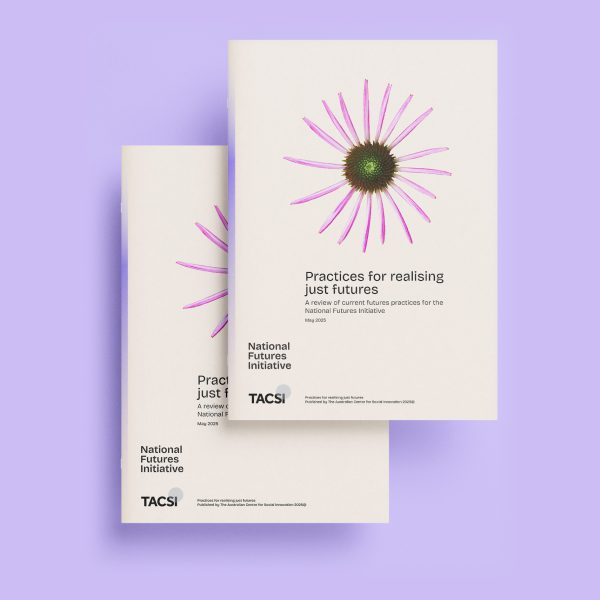
In this paper we share what we’ve learnt from a review of existing futuring practices to inform our work and hopefully support your work too.
Who is this paper for?
- For-purpose leaders looking to develop future orientated strategy
- Practitioners with an interest in futures
- People leading Initiatives to create more socially just futures around the world
- Communities working to amplify and legitimise their futuring work
- Our partners in the National Futures Initiative
- Anyone wondering what you can do to navigate what’s coming down the line in this second quarter of the 21st century!
Our approach
We gathered 170 examples of current projects, networks, alliances, individuals and governments working on futures from Australia and overseas that we categorised into nine families of futuring practices.
This included a review of peer-reviewed scoping papers, conceptual papers, empirical studies and grey literature around particular futures approaches and practices. We also connected with a number of practitioners in the field.
What we learnt
- Futures initiatives that lead to real change are typically part of a broader system of activities aimed at bringing those futures to life. These systems often connect diverse actors, enabling them to engage in collective imagination work that directly shapes strategy and resource allocation—resulting in compelling demonstrations of new possibilities and wider influence and adoption.
- Futures practices have greater potential to enhance social justice and expand our sense of possibility when they draw from multiple knowledge systems, such as Indigenous knowledges, lived experience, and scientific understanding. This is distinct to futures practices grounded in a singular knowledge system.
- Futures experiences have the potential for greater effect when they are designed to build over time through a mix of formats and levels of engagement. This approach supports different ways of learning and is more accessible for a wider array of people to take part.
Download the paper
Fill in the form below to download the paper. A download link will appear on submission.
We’ll also send you an email containing the link for future reference.
"*" indicates required fields