
What is Fire to Flourish?
Since the devastating 2019/2020 summer bushfires, there’s been a growing movement for community-led responses that reflect the priorities of local communities and respond to local context.
TACSI is proud to be a foundation program partner in Fire to Flourish, a five-year, 5m partnership between Monash University, Paul Ramsay Foundation (PRF) and Metal Manufacturers Limited, designed to grow the power of community-led action in bushfire-affected communities by developing novel approaches to strengthen community resilience.
Working closely with communities affected by the 2019/20 summer bushfire, the program seeks to:
-
Develop, test and refine a new model for community-led resilience that supports communities in bushfire recovery areas to co-create the foundations of long-term resilience and wellbeing
-
Build an evidence base to demonstrate what can be achieved when communities are not just recipients of bushfire recovery funds, but are supported to lead their own resilience-building
-
Connect with government, agencies and other stakeholders, and provide mechanisms for shared learning and coordinated action
Our role
We lead the Innovation Team, who is responsible for designing and demonstrating new practices, mindsets and ways of working in partnership with diverse communities.
We help communities build holistic resilience, through a strength-based, community-led approach. Our team is busy designing, delivering, and integrating the innovation work into the broader program.
Our current focus
- Building new capability within communities, co-designing innovations and helping potential leaders step into new roles
- Focusing on mindset and real adaptive problem-solving by fostering learning across communities, and connecting them at a national level to learn from one another
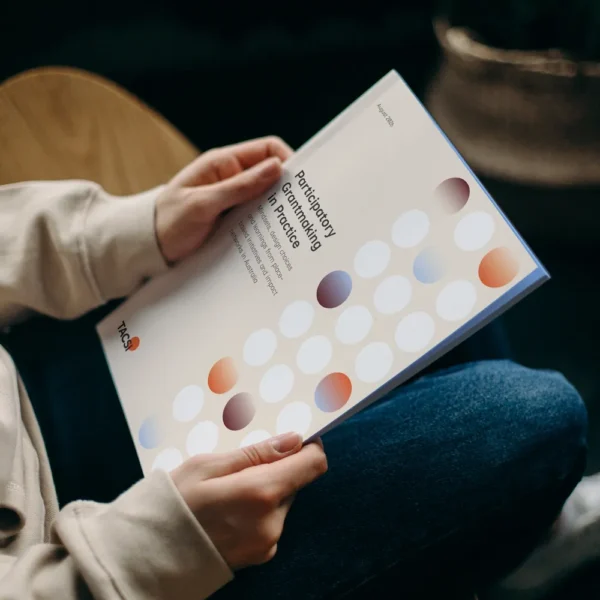
- Using participatory granting, which means community participants will decide where the bucket of funds allocated to them gets spent
- Designing, documenting, replicating and scaling tools, processes and resources for supporting community-led resilience building
Our key community engagement activities
-
Designing and delivering capability building activities
-
Leading community foresight through ‘Now, Future, How’ processes
-
Leading engagement with Indigenous communities and institutions;
-
Convening community leadership teams in co-design groups;
-
Designing and implementing participatory granting process.
The key components being designed and tested
- Capability building: What kinds of local actions deepen community-led capacity to cope, adapt and transform their social, economic, built and natural environments?
- Network learning: what kinds of local actions deepen community-led connection and adaptive learning?
- Participatory granting: What kinds of local actions deepen community-led agency, sustainability and long-term access to resources?
- Innovation ecosystem: What kinds of local actions foster community-led innovation ecosystems that influence systemic change?
The Innovation team is testing and learning about new ways of working with fire-affected communities to co-create the foundations for equitable, long-term resilience and wellbeing, including participatory grant-making activities.
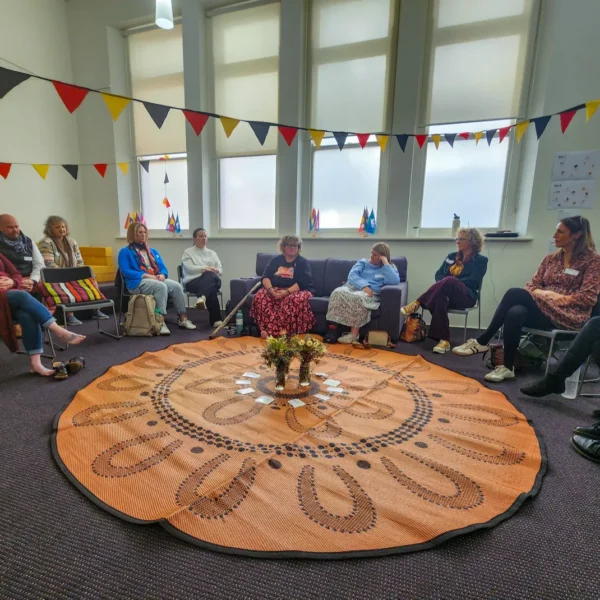
Recently, we have been working in Clarence Valley with a small group of community change-makers exploring new ways of self-organising around strengths and mobilising towards desired futures including:
- Community-led practices, problem solving, and participatory decision making processes
- Building networks and learning alongside communities facing similar challenges
- Imagining resilient and sustainable futures
Specifically, in each community we are testing and learning about ways to:
- Deepen resilience capability to see strengths, imagine futures differently, and create and invest in new ways of getting there
- Seed a creative and participatory innovation ecosystem
- Build an adaptive learning network across communities
We’ve also been supporting the development of a research program that will build an evidence base for how community-led resilience building can be achieved in practice.
Our incubator work in Clarence Valley is informing the design and scaling of the impact program and design of research that will be part of the broader Fire to Flourish program activated in subsequent communities.
The work in Clarence Valley has unearthed four overarching learnings that are threaded across the above components. These learnings demonstrate the transformative potential of our approach, and are evidencing what’s required to build resilience capabilities and cultural change in focus communities.
These four learnings are:
- Reconciliation and connection to Country is the first step to resilience: Creating allyship in the process & learning from First Nations Peoples.
- Healing and story work: Building connection, empathy and new understandings between the group through story work
- Power to mobilise and influence: Connecting people, wisdom and resources within and across communities for deep impact across scales
Imagination and hope: Developing a culture of experimentation and ‘what if’ by learning and doing together, surfacing hope, and future possibilities
We see the next step as realising a repeatable approach for supporting multiple communities to travel a multi-year journey, including community-led resilience planning, granting and governance.
The Fire to Flourish community-led model is founded on a different set of values to mainstream approaches and therefore needs to be incubated outside of formal systems.
We see our role in creating a demonstration for new practices, mindsets and partnership ways of working (for example, between Indigenous and non-Indigenous Australians) – but without building it and embodying it we won’t know what is needed. The demonstration will give us something concrete to point to, for people to visit and to influence change in the broader system.
In 2022 in particular, we’ll be building infrastructure for innovation by developing a ‘Community Innovation Hub’ that will:
- Integrate Innovation & Research expertise alongside lived experience
- Design, build and scale capability building and participatory granting
- Activate the program across all four focus communities
- Be a vehicle for investment & scale beyond the program – a new kind of community institution
Our goals for the end of the program are:
- Participating communities have strengthened their disaster resilience in ways that address structural inequities
- Self-sustaining national systems of community connection and learning are strengthening resilience
- There is strengthened system conditions and capabilities for community-led resilience building that addresses inequities
- There is an evidence base on what creates change for communities in diverse contexts and what creates change in broader systems.

Our commitment to First Nations First
We’re weaving First Nations thinking into this initiative by:
-
Following the core principles of Foregrounding Aboriginal Wisdom and Healing
-
Using a co-developed approach to cultural awareness training for communities, facilitating collaboration between local First Nations knowledge and the William Cooper Institute team at Monash University
-
Creating a cultural safety plan
Our current interdependent First Nations activities include:
-
Indigenous relationship development including with NSW Aboriginal Lands Council, NSW Aboriginal Affairs, Bushfire Recovery Victoria and Clinton Schultz
-
Developing a Cultural Foundations Plan with Dr Brian Martin
-
Review and advise on an Indigenous Engagement Project Officer role job description
-
Active members of the Indigenous Partnership Group, including relationship development between meetings.