The background
Family, domestic and sexual violence (FDSV) is a public health crisis with profound and long-term impacts. While many people impacted by violence may never access specialist family, domestic and sexual violence services, most will engage with the primary health system at some point.
This creates an important opportunity for general practices and primary health services to play a role in recognising signs of violence, responding safely and connecting people to the right support.
However, primary care professionals – particularly general practitioners – face significant challenges in taking up this role. These include time and financial constraints, limited integration with the social services sector, and gaps in family, domestic and sexual violence knowledge and training.
The supporting primary care response to family, domestic and sexual violence PHN Pilot meets primary care professionals where they are. It supports them to understand where they fit within the broader system response and gives them the confidence, tools and pathways to act safely.
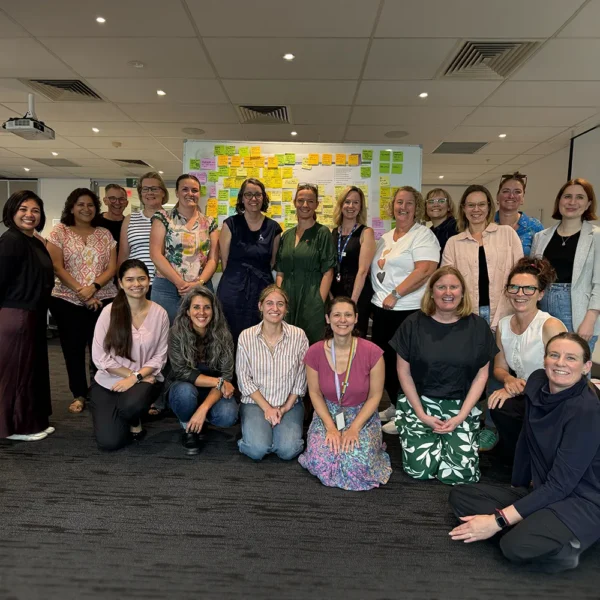
The model was first developed in 2018, after the release of the Not now, not ever report, when Brisbane South PHN engaged TACSI to design a model to support primary care in formally playing a role in an integrated response to domestic and family violence.
Since then, TACSI has worked alongside Brisbane South PHN from discovery and design through to detailing, implementation and scale.
The current model has now been co-designed across all states and territories. It offers scalable implementation principles and core activities, while allowing for localised approaches that support primary care to contribute to the national response to family, domestic and sexual violence.

Our approach
Primary care professionals are uniquely placed to respond to family, domestic and sexual violence, but they need the confidence, capability and system support to act in this complex area.
The model was designed to bridge two worlds that have often operated separately: primary health care and specialist family, domestic and sexual violence services. Its intention is to create a more integrated public health response, strengthening the connection between clinical care, specialist support and local service systems.
With TACSI’s support, the model was first co-designed in Brisbane South through several iterations of research, design and development. TACSI’s social practice enabled a deeper understanding of gaps and needs from three distinct perspectives:
- Victim-survivors, engaged in trauma-informed and anonymous ways
- Primary care professionals, understood within their real practice environments
- Family and domestic violence sector experts, who shared insight into the impacts of effective and ineffective responses
TACSI’s analysis and synthesis of this qualitative data created an evidence base that informed the design and direction of the original model.
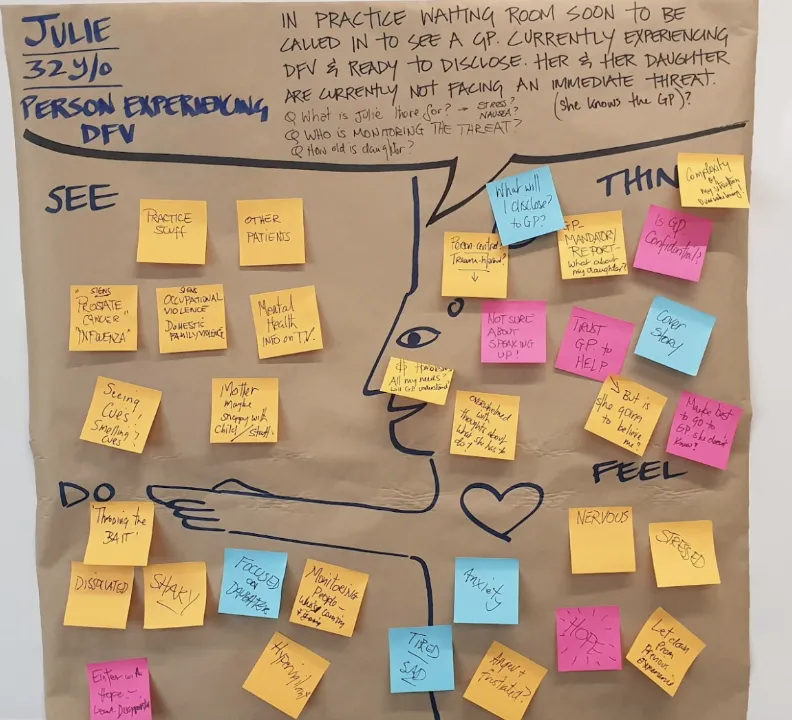
Following the initial model design, TACSI supported a dedicated phase of work to understand how the model could better meet the needs of people from diverse communities experiencing family and domestic violence. This work has continued to inform the model’s expansion into other PHNs, ensuring diverse needs, identities and preferences are reflected.
This has helped shape a model that supports people experiencing family, domestic and sexual violence to:
- Feel culturally safe and welcome in general practices
- Feel safe to disclose violence in general practices
- Feel believed and supported to make informed choices about their safety and wellbeing
- Have their health needs appropriately addressed
- Receive a response and ongoing care that is appropriate to their identity, experiences and needs
In 2023, TACSI worked with Brisbane South PHN to develop a practice manual, service blueprint and quality indicators. This helped articulate the nuanced workings of the model, the interactions within it and how these contribute to outcomes.
The work also helped clarify three key aims of the response:
- Building a climate of awareness within primary health
- Creating a climate for disclosure for patients
- Helping patients receive the right support
Over the last three years, TACSI has also worked with Brisbane South PHN, the additional 11 pilot PHNs and key partners to understand what is needed for scale. As the model has expanded, it has grown to include sexual violence, including child sexual abuse, and continues to build the capability to respond to people who use violence.

The model
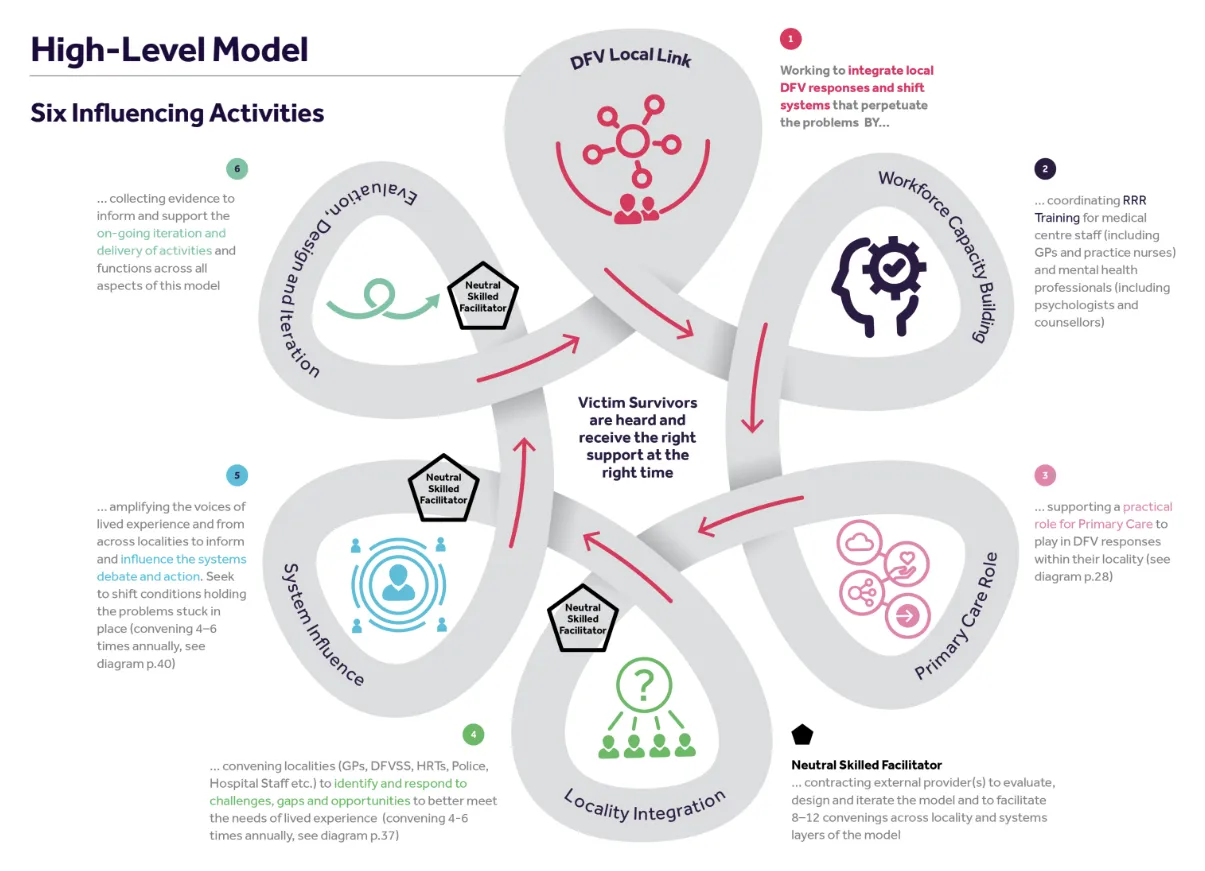
The design phase produced a model with six core influencing activities. Each activity works together to create the conditions for maximum positive impact.
The six core activities are:
- Specialist linking role — increasing family, domestic and sexual violence capability, providing real-time advice to GPs, supporting patients and creating bridges to specialist services.
- Workforce capacity building — building primary care workforce confidence to recognise, respond and refer safely.
- Whole-of-practice approach — ensuring all staff within a practice are confident and equipped to act.
- Service integration and continuity of care — strengthening collaboration with local related services.
- System influence — linking primary care and specialist practice to support broader system change.
- Accountability and continuous improvement — embedding measurement, evaluation, learning and iteration.
Together, these activities support general practices and primary health services to become safer and more effective entry points for people impacted by family, domestic and sexual violence.
The insights
This model provides a critical example of the design, implementation and scaling of an integrated and systemic response to family, domestic and sexual violence across Australia.
The six core activities have extended the work beyond service design and delivery, supporting a broader conversation about system change. The model contributes to all four pillars of the National plan to end violence against women and children 2022–2032 by strengthening recognition, response, referral, system integration and prevention capability across primary care.
Key insights include:
- Primary care has a vital role in the family, domestic and sexual violence response, but practitioners need practical tools, clear pathways and real-time support.
- Bridging primary health and specialist family, domestic and sexual violence services creates safer and more coordinated responses for victim-survivors.
- Localised implementation matters. A scalable model is strongest when it can adapt to the needs, strengths and service context of each community.
- Whole-of-practice capability building helps make family, domestic and sexual violence response everyone’s responsibility, not just the role of individual clinicians.
- Sustained system influence is needed to strengthen referral pathways, build shared accountability and improve continuity of care.
Building on the model, the pilot is now supporting more advanced conversations with GPs, allied health professionals, government and system stakeholders about how to work safely and effectively with people using violence.
What’s next?
Originally co-designed in Brisbane South in 2018, the model extended its localised learning through six locations in 2020, before scaling to a further five locations in 2023.
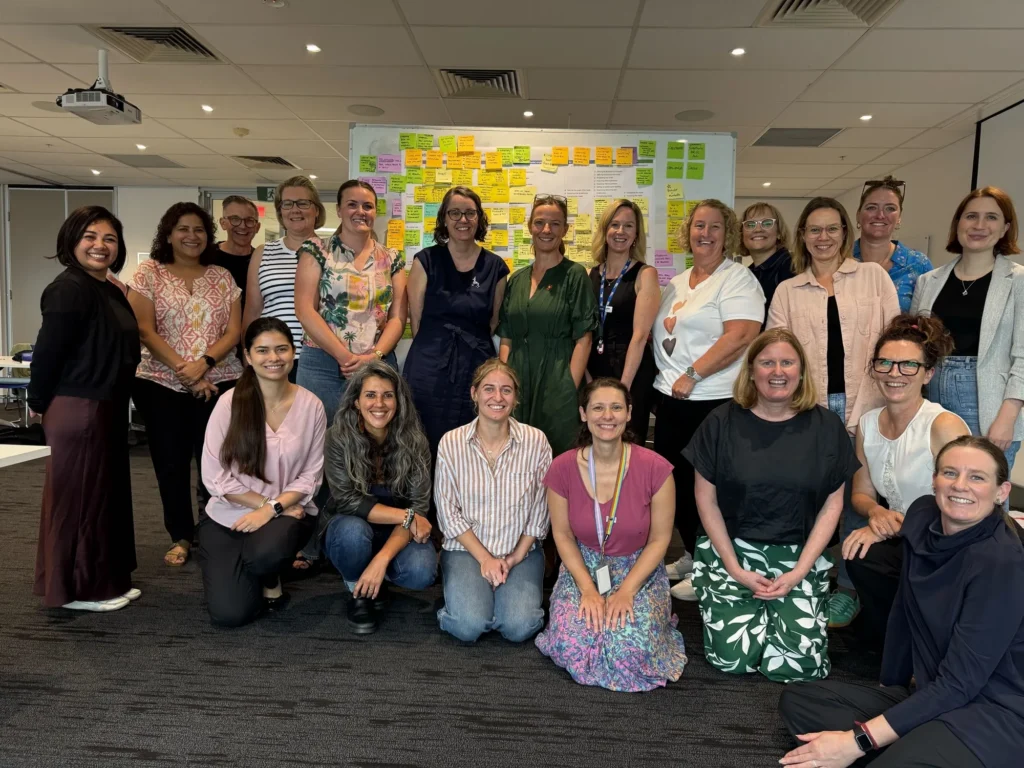
The design has evolved through collaboration between Brisbane South PHN, as the National Lead PHN, a community of practice and 12 Primary Health Networks across Australia. TACSI has supported all 12 PHNs to co-create a scalable core model and document each localised approach, so future scaling projects can learn from their experience and increase efficiency over time.
From 1 July 2022 to 30 April 2025, the 12 participating PHN regions delivered:
- 721 training sessions
- 3,751 training attendees
- 8,446 meaningful interactions between System Integrators and primary care staff
- Engagement across 1,124 practices
Training reached a broad cross-section of the primary care workforce, with most attendees working in medical practices, including practices with two to five GPs and practices with more than 11 GPs.
Participating PHNs also strengthened system integration through formal partnerships, inter-agency forums and the development of referral pathways to specialist services.
In February 2026, the Australian Government announced a $22.7 million investment to extend the national pilot program, supporting general practices to identify, support and refer victim-survivors of family, domestic and sexual violence.
The aim is to scale from the existing 12 PHNs to 31 PHNs, and ultimately build the confidence and capability of Australia’s 40,000 GPs.