Introduction
The Parents as Partners pilot is an initiative developed by the Hume Merri-bek Smart Service Network, a collaboration between the Department of Families, Fairness and Housing (DFFH) and community organisations, to support families experiencing ongoing difficult life circumstances, aiming to improve engagement and support for parents.
The pilot has now been running since January 2026 through Uniting Vic. Tas. (Uniting) and early evaluation insights are showing:
- Positive relationships with Parent Mentors
- Increased happiness
- Improved family relationships
- An increased sense of hope associated with the lived experience of Parent Mentors
- Increased connection and trust with services.
In 2024, TACSI and Clear Horizon supported a group of co-designers to shape a Service Blueprint and Theory of Change, both of which are guiding the pilot to date.
The following steps out what we did together in the co-design process.
Background and context
The Hume Merri-bek Smart Service Network has identified families with children who remain locked in cycles of tough times. For the most part:
- The system around these families is aware of their tough times. Many of these families are receiving support regularly yet things don’t seem to be getting any better and;
- Some of these families are not connected to any support at all despite the complexities they are grappling with day to day
Peer to peer responses have been identified and evidenced in the context of Family by Family as a powerful strategy for overcoming challenges and providing family support and engagement that made a difference.
Due to their shared experience of living through adversity and working alongside professional services successfully, peer workers known as parent partners in the pilot are uniquely positioned to engage and build trust with parents, provide emotional support, facilitate community linkages, and inspire optimism and hope.
DFFH and Uniting fulfilled a commitment to co-designing a robust, scalable parent partner program to advance meaningful family support and are now piloting it using the blueprint and theory of change designed to support its implementation.
The process
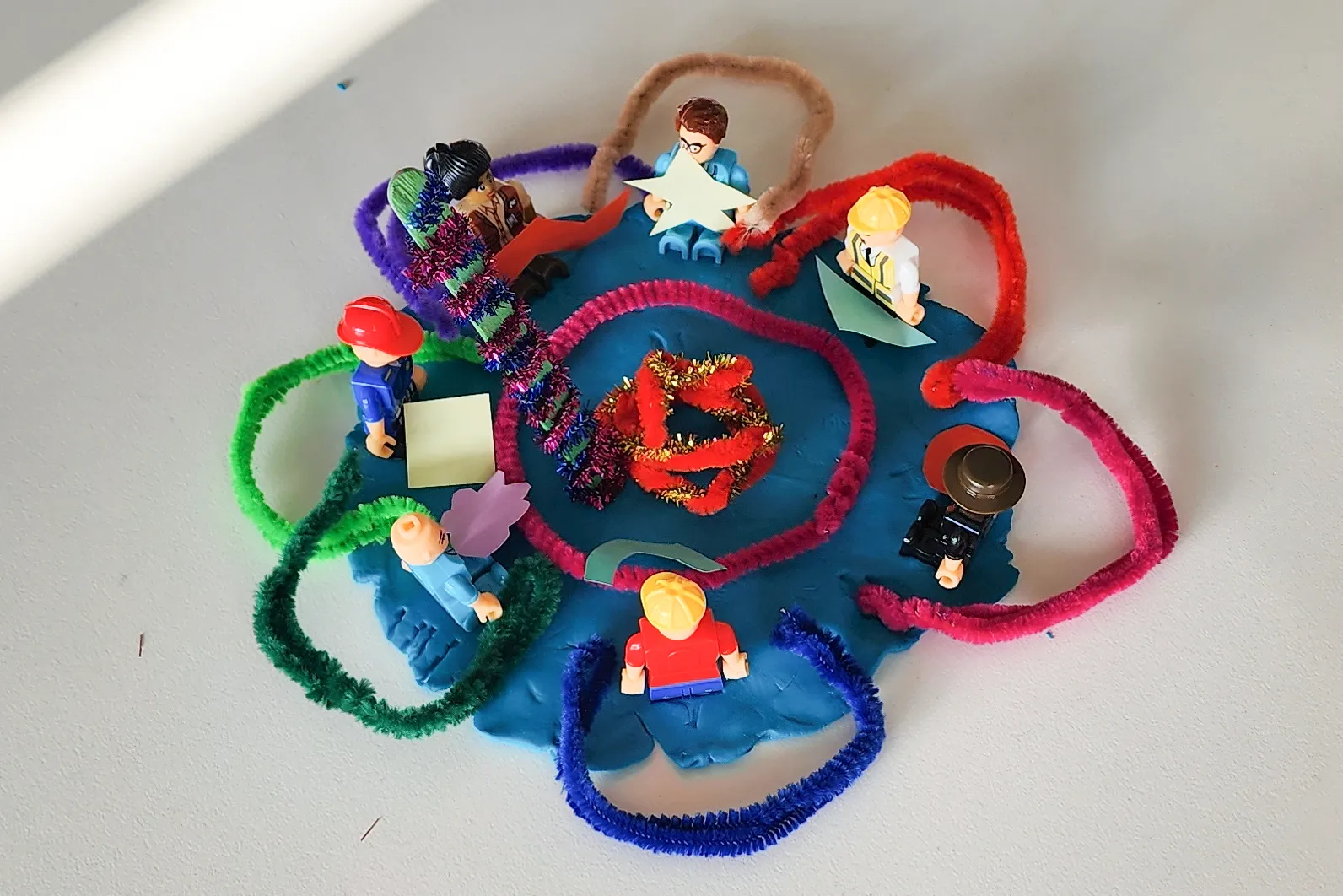
Supported by TACSI and Clear Horizon, a group of dedicated and diverse co-designers came together across four collaborative workshops. The design team included parents with a lived experience as Lived Experience Experts, who were remunerated for their participation and provided support to participate.
Prior to the workshops each co-designer participated in pre-conversations that set some foundations for working together.
This pre-work enabled us to:
- Shape the safe enough, brave enough groups commitments that would guide collaboration
- Surface emerging insights that gave us a shared understanding to spring from
Across the four workshops the co-designers created:
- The Theory of Change articulating the activities and associated outcomes of the pilot
- An initial high-level service blueprint to support initial implementation
- Recommendations for next steps
The insights
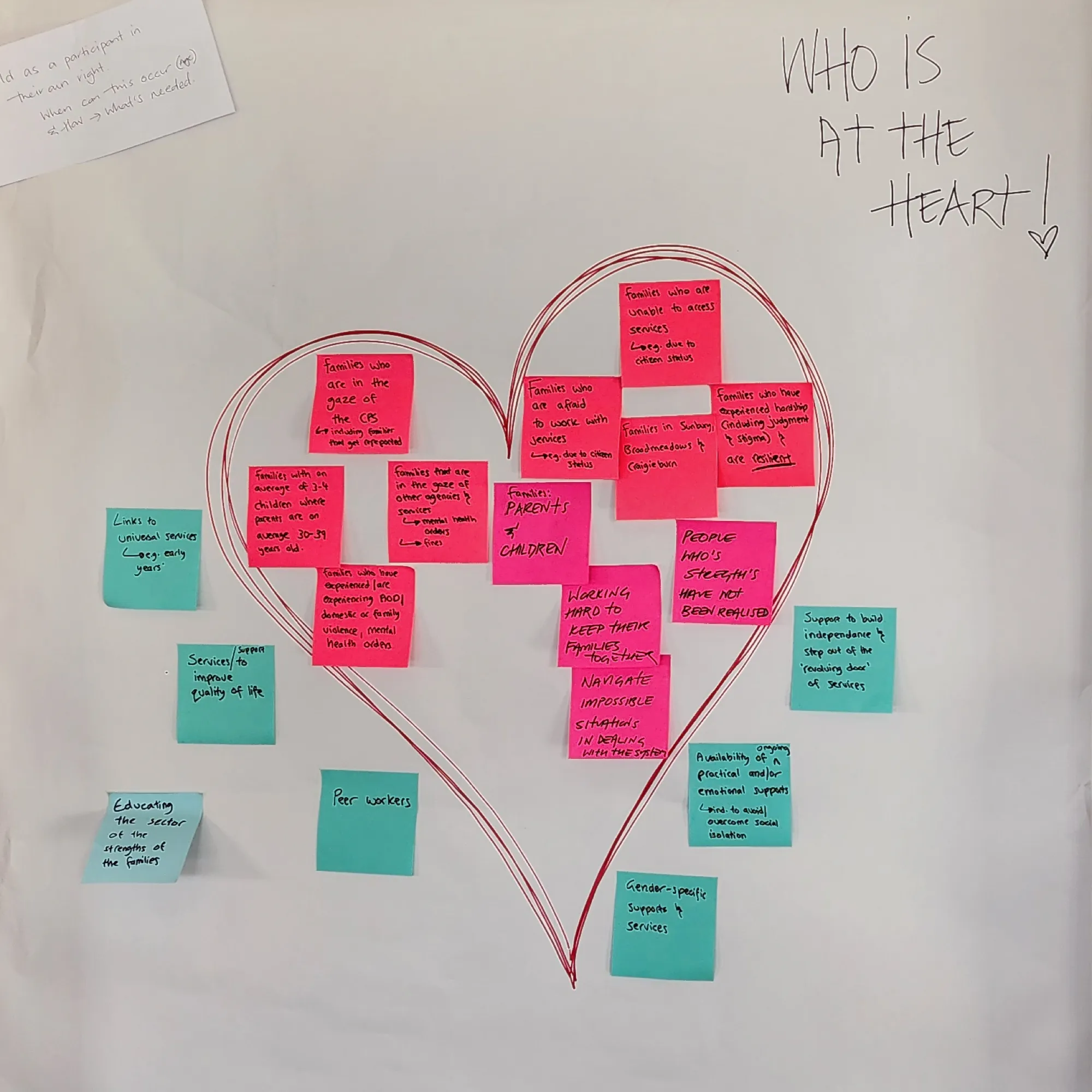
The pre-conversations unearthed a series of insights (some as seen below) that supported us to come together as a group, give us collective insights to spring from, and set the course for shaping the blueprint and the Theory of Change:
- The unique role of Parents as Partners is about enhancing and complementing the work of formal services & meeting the families where they are at, where service responses are limited to do so.
- Culturally-led peer responses are about recognising the unique need for cultural responses that respect and reflect the cultural diversity of families and collaborate with peer responses that are already underway and making a difference in community (for example Aboriginal and Torres Strait Islander Dads’ programs).
- An ever present child focus is about always focusing on the priority of the safety of a child and embedding them in the program in their own right.
- Working with services and the system differently is about the potential of the Parents as Partners pilot to be contributing to increased partnerships and capability across the system, focussed on expanding a strengthened collective response for families.
- Walking alongside families experiencing cycles of harm is about not framing the peer response as another service families must attend.
- Building capability for leadership is about enabling the potential for lived experience leadership within and across the pilot to support the on the ground peer response.
- Shaping the right peer response looks like an encouraging, empowering, non judgemental response that supports families to realise/remember their own strengths and build new strategies.
- Going beyond goal setting is about avoiding working on goals of the system and rather a focus on working on what matters most to families through their choices and pace.
The outputs
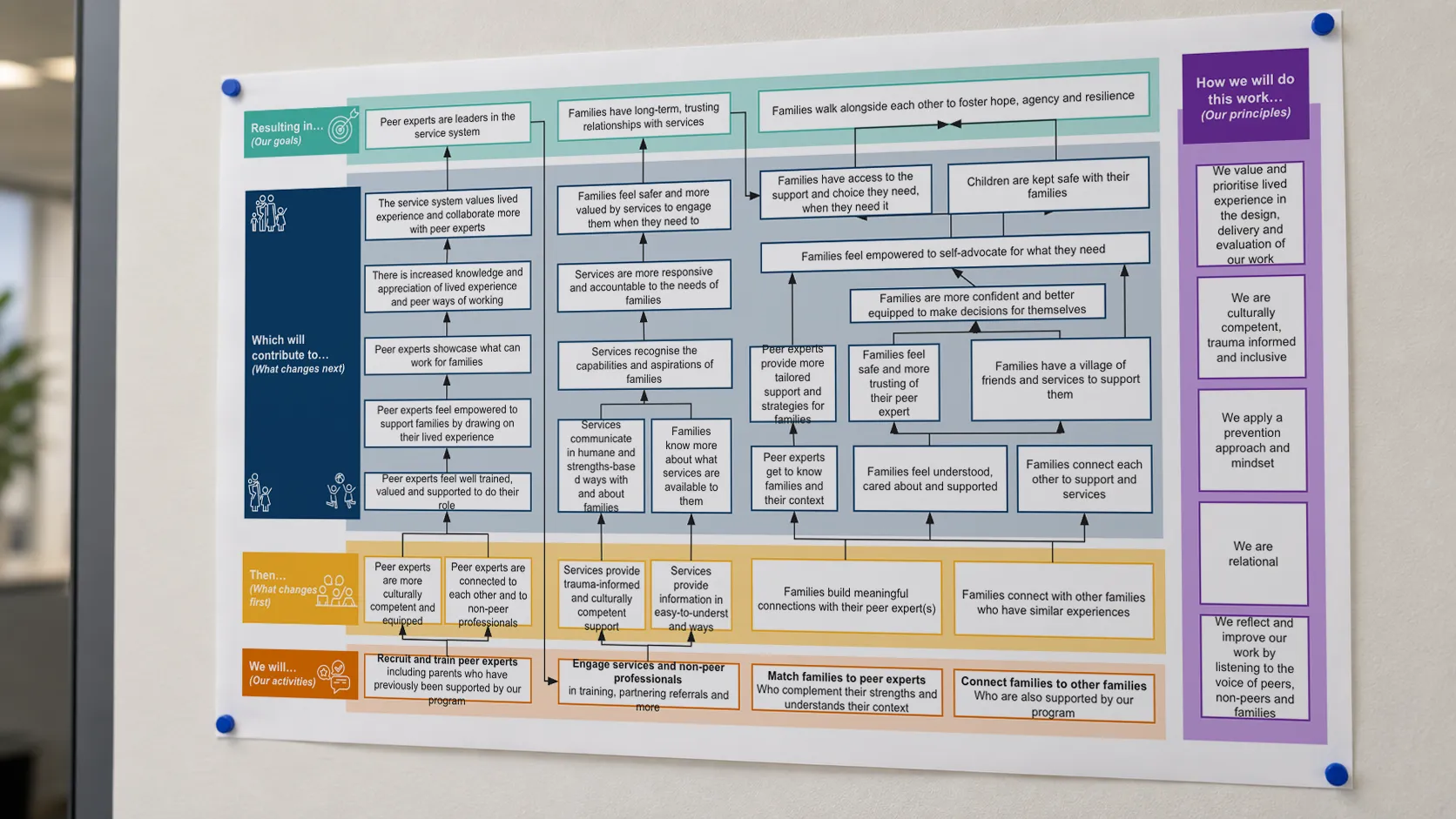
The first output was the co-designed Theory of Change, which articulated what the Parents as Partners pilot would do (its activities) to create positive social change for families, their children and the broader service system (resultant outcomes).
The Theory of Change was built across the four workshops. Following the pre-consultation workshop, Clear Horizon drafted elements of the Theory of Change using the words of the co-designers. These drafted elements were brought to the first two workshops, where they were carefully considered and then reconstructed by the co-designers.
The co-designers first identified three broad goals of the pilot:
- Peer experts are leaders in the service system.
- Families have long-term, trusting relationships with services.
- Families walk alongside each other to foster hope, agency and resilience.
Co-designers then determined the activities to be delivered by the pilot. These are:
- The recruitment and training of peer experts;
- Engagement of services and non-peer professionals;
- Matching families to peer experts; and,
- Connecting families to other families.
Finally, the co-designers mapped out the causal pathways, the ladders of incremental change that would result in the pilot’s activities contributing to its three goals.
Once the Theory of Change was drafted, it was revisited and updated at the third and fourth workshops as the service blueprint began to take shape.
The Theory of Change also outlined how the Parents as Partners pilot would undertake this work (principles), recognising the importance of how families are engaged by the system.
The pilot’s principles are as follows:
- We value and prioritise lived experience in the design, delivery and evaluation of our work.
- We are culturally competent, trauma-informed and inclusive.
- We apply a prevention approach and mindset.
- We are relational.
- We reflect and improve our work by listening to the voice of peers, non-peers and families.
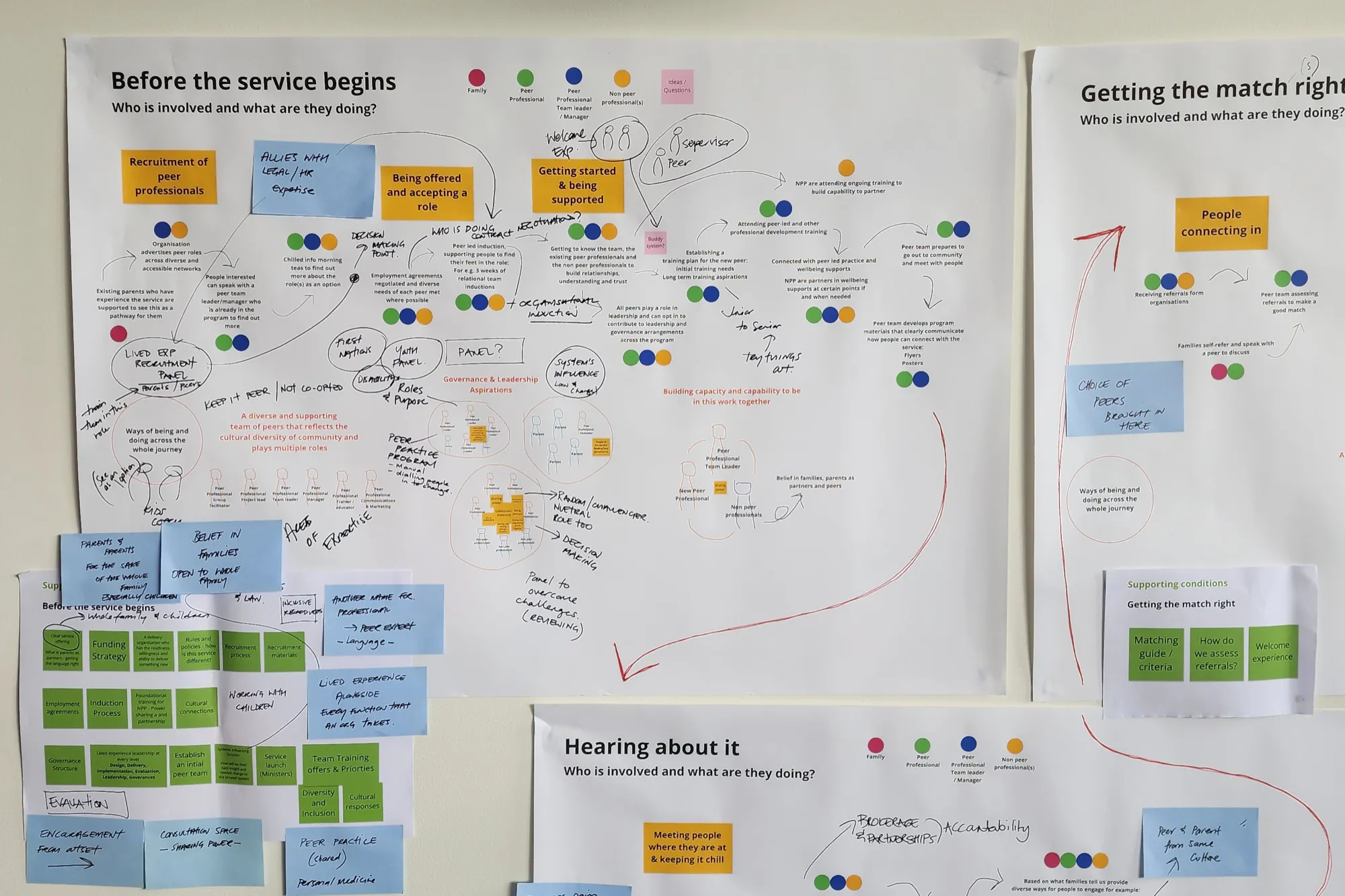
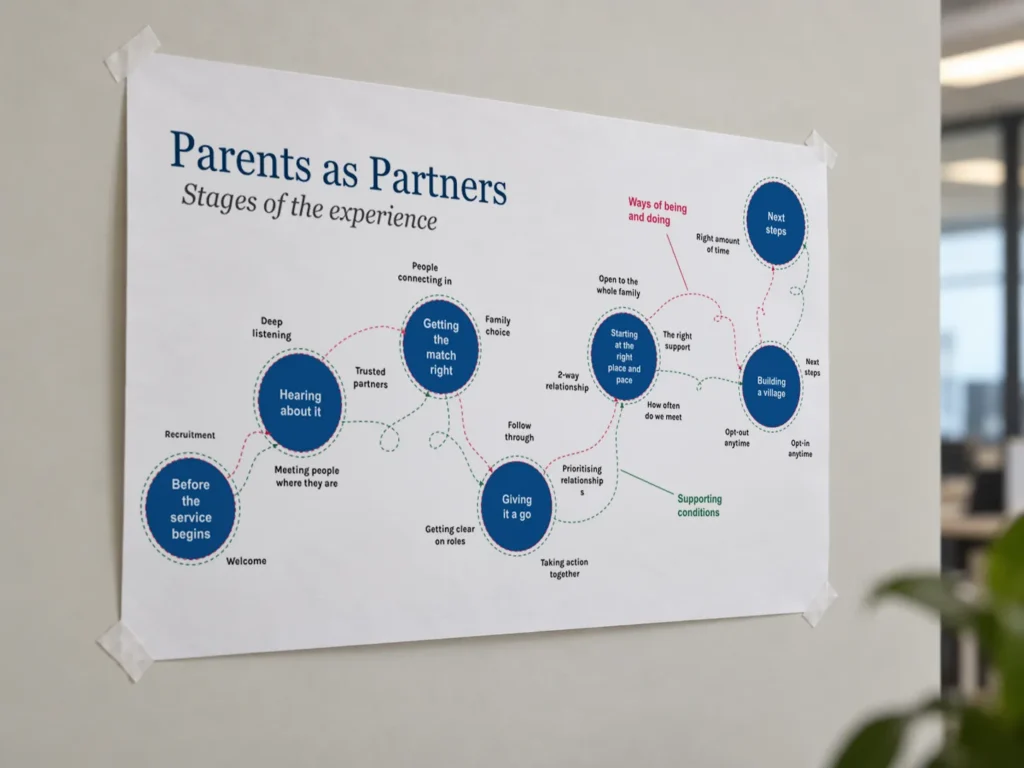
The second output was a program blueprint that articulated seven phases of the program experience, outlining what happens and when across the program journey. They are:
- Before the service begins
Aim: Establishing good foundations through recruitment and onboarding of Peer Mentors - Hearing about it
Aim: Earning trust with community and partners through deep listening and meeting people where they are at. - Getting the match right
Aim: Creating diverse connections through invitation and choice. - Giving it a go
Aim: Seeing the potential to move forward together and getting things underway. - Starting at the right place and pace
Aim: Being in this together by setting up a 2-way relationship and how and where to meet. - Building a village
Aim: Building more than a network of services around families — rather a community that has the potential to last for a lifetime. - Next steps
Aim: Never leaving a family behind without their chosen supports and self determined next steps
The co-designers also named a number of key ways they wanted the program to show up for families including:
- Family choice, always
- Families are seen as strong and resilient with boundless potential
- There is investment and ongoing commitment to being peer-led
- Non-peer professionals are trusted allies that can provide technical and different expertise
- Governance and leadership structures reflect the families at the heart of the service, through sharing power, collaborative confidence, shared understanding, naming and working through tensions and seeing and responding to risk together
The co-designers also name a number of supporting conditions that needed to be in place to support the program’s success including:
- Commissioning a delivery organisation committed to sharing power and ongoing learning
- Investment in an evaluation & learning framework
- Funding an initial peer team to implement the program with a test and learn approach
- Investing in Cultural Connections and the starting with relationships
What happened next
Following the robust codesign, Uniting developed a business case and implementation approach for a trial of the Parents as Partners model. With funding support from DFFH, a small-scale trial began in late 2025.
- The Parents as Partners team consists of a coordinator and three parent mentors with lived experience. The pilot was fully operational by January 2026 with parents and families being matched and project governance including paid Lived Experience Expertise underway.
- The Parents as Partners pilot aligns with the Department of Families, Fairness and Housing’s Family Services Strategic Framework and its commitment to lived experience and the development of consumer-led services.
- The pilot aims to support families to reduce the stressors associated with poverty, social isolation and other harms, and to engage more effectively with family services and other supports to meet family-identified needs in the prevention of cumulative harm, and to promote engagement to support services such as Family Services.
- The pilot continues to work in a manner that is consistent with the approach and details of the Parents as Partners Model, Theory of Change and Service Blueprint prepared for the Department of Families, Fairness and Housing by Clear Horizon and TACSI.
Looking to safely embed lived-experience and peer-to-peer models in your service system?
TACSI provides the relational scaffolding, co-design expertise, and governance frameworks needed to integrate peer models into heavily regulated systems.