
Finding a new way to work is becoming a matter of survival.
No matter where in the world your business is located or what sector you work in, the ground has shifted under the old hierarchical corporate model.
There are volumes of literature written on why this is happening and why it had to happen, based on the way our society has been evolving since as far back as the Industrial Revolution.
Connected, TEAL, networked, decentralised or learning organisations are rising as the way forward. They do away with traditional power structures to offer workplaces which are fulfilling, vibrant, self-renewing, sustainable and – very importantly – commercially successful.
The concept is as exciting as it is elusive. Of all the organisations making the shift away from traditional hierarchies – and there are a lot of them – there are few who actually succeed.
Corporate Rebels, two of the most visible management thinkers with this focus, can name only 170 worldwide. It’s easy to see why. Becoming a networked company is much more than implementing agile methodology or shifting towards more transparent digital systems. It’s about challenging power, looking differently at trust and risk and how we see ourselves.
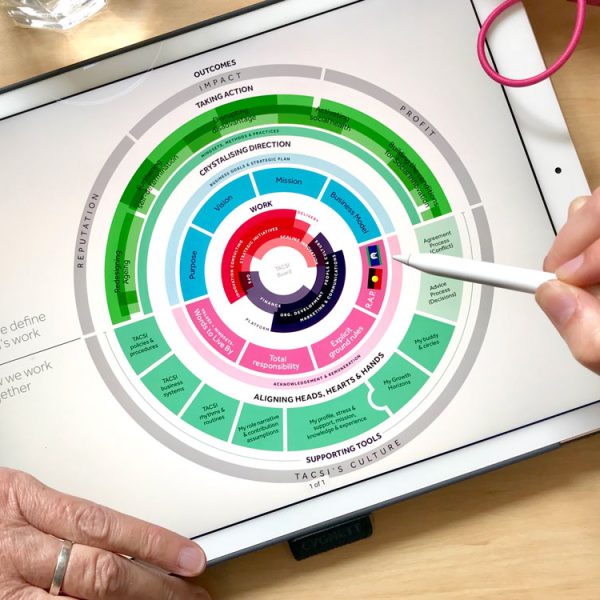
Our vision of a networked organisation at TACSI is that of an operating model capable of responding to an ever-changing environment. It is forward-facing, structured around people learning from the emerging future rather than seeking instruction from the past. It is authentic, completely transparent and always evolving.

Realising we couldn’t afford not to change
For TACSI as a national centre for social innovation, the need to change was existential in nature – hierarchy is anathema to evolution and innovation. How could we fulfil our mission if we weren’t brave enough to live by it? How could we demonstrate meaningful change to other organisations if we couldn’t do it ourselves? We wanted to be more authentic.
We also knew we needed new and better ways to look after our people. The work we do is inherently complex and it draws people who are passionate and committed – they will do whatever it takes. Burnout is a real risk in this sort of workplace. If we wanted TACSI to be a sustainable business, we needed our operating model to keep people well. Simply put, we couldn’t give what we didn’t have.
Our business has also always attracted people looking for something more than a crisply defined role in a great production line. They exemplify in many ways the next-gen workforce, desiring most of all to do something meaningful in the world. They felt a real sense of purpose in their chosen careers, and they wanted a stake in the organisation in which they were so personally invested.
The emerging benefits have been well worth the risk
We want to share our experience and our journey in this series because the change – even at this point – has absolutely been worth it. We see real value in it, for every organisation. The benefits we’ve seen already for our business and our people are inspiring. By keeping decisions close to the work, we are able to respond in ways that are meaningful and effective.
We designed a system that rewards behaviours that support our culture, rather than achievements, and now our culture is a key consideration in everything we do. People are beginning to bring more of themselves to work; they never feel that they’re required to be a different person in their working life. They are more comfortable being vulnerable in offering ideas or sharing concerns. A flatter, leaner structure allows us to capitalise on the diverse skills – both professional and personal – of our workforce.
These behaviours and this culture aren’t incidental to our success – they enable our success. But it takes effort, vulnerability and courage to start things working this way, and more to keep them there. Starting that journey is exhilarating and frightening, and it pays to be prepared. We thought we knew what we were doing, and that was probably our first lesson.
A transformation (always) in progress
This series isn’t so much a guide as a personal account; rather than a map, we hope it offers a light and a compass. It’s the lived experience of what it’s been like for us to make significant, scary changes to our organisation in pursuit of a very worthy goal. It’s everything we wish we’d known before we started.
Each chapter covers an area we think merits some deeper exploration. The process is necessarily unique to every business, but we’ve tried to touch on some of the points which will apply universally. Importantly, we’re not there yet and likely never will be. To be constantly learning and changing is the point – you’ve never really ‘arrived’ on a journey like this.
Read our journey

1. Expert advice isn’t always helpful.
Bringing in an ‘expert’ who doesn’t understand your business and what it’s trying to achieve can be counterproductive. You are already surrounded by experts when it comes to working out what needs to change in your business. They’re the people who work there.

2. You’re going to need resilience as a leader
People will leave. Staff will tell you it’s too hard, that the new way is over-complicating day-to-day operations, and – probably more than once – that you’ll send the business broke. Digging in your heels and staying true to the vision is really, really hard in the face of negative feedback.

3. The learning and the change start with you
Redistributing power will be one of the biggest challenges. We all like to believe we’re humble and in control of our ego, but a hierarchy invisibly supports a lot of notions about who we are which can be difficult to give up. Some will struggle to stop being ‘in charge’; others will have difficulty assuming responsibility. Success for your organisation will require a commitment to self-mastery – an inward journey of reflection and growth – for everyone, and it has to start with you.

4. See your business as a system
It’s not just about new routines, rituals and structures; these should be the natural products of deeper, systemic changes to culture and behaviours.

5. Remember it’s about function over form
Most businesses are driven by the opposing principle, adhering to power structures so strictly that their driving function is neglected or forgotten altogether.

6. Expect your experience to diverge from what you’ve read (a lot)
There’s no real ‘how to’ for successfully decentralising your organisation. You will probably have read a lot of books and guides on the process. Be prepared for the likelihood that nothing you’ve read will work for you, and be ready to carry on regardless. We found that most of the literature was describing a destination, and not how to make the journey there.

7. Let go of what you think needs to happen, and instead embrace what emerges naturally
The process is about responding to change in a way that is productive and enables learning. Sticking too tightly to your priorities will prevent you from recognising needs and opportunities as they emerge, which will stifle the very change you are trying to make.

8. The process takes time and change has to happen at a pace that works for everyone
Milestones are important but it’s difficult to impose a timeline on something which is ever-evolving. After three years, we still have so much we haven’t ‘achieved’, and we expect that as we continue to change, so will our goals.
9. It’s hard to ‘stay true to your vision’ when your partners and customers don’t work that way
The challenge of maintaining a networked structure when marketplaces seek out a hierarchy can be discouraging. You need to find a way to interface with clients who work according to traditional power structures, without reverting to them yourself.

10. One more thing – while you’re changing everything, everyone still needs to get paid
A huge challenge which is often overlooked is the necessity to keep everything turning over in your business at the same time as you’re trying to change the way you work. The phone doesn’t stop ringing because you’re building a new dream.

11. Post-Covid – did we make the right decision to decentralise TACSI?
No matter the size or makeup of your organisation, it will have faced unprecedented hardship in 2020. For TACSI, it represented the ultimate test of our fledgling decentralised model – we’ve been discovering whether or not our big gamble has paid off
This journey has been messy, with just as many mistakes and missteps as successes
We certainly made things worse before making them better. However, we also knew that to attract and retain the best people to tackle some of society’s biggest and most complex issues, we needed to be different, and that belief remains.
Decentralising toolkit
Read more about how you can network your organisation, and download the assets we designed to bring our team along on the journey.